Wednesday, April 11, 2018

Meteoric Meteora Greece

Over this past Easter Holiday my wife and I, and Tyrone a fellow Peace Corp volunteer travelled to Kalampaka, Greece.  This is a town in north, central Greece - and a bit off the usual tourist trail.  This area is famous for ancient monasteries built upon towering rock columns.  This World Heritage Site is well worth a visit for its testimony to human accomplishment, religious dedication, and just plain awe.  The food is pretty good as well.  First, no description is complete without a bit of geology.  For you non-geologists, this is your cue to go let the cat out.

This unique region in Greece sits on a broad river plain; and in the uplands are towering rock formations, hundreds to almost 1000 feet tall.  These rock towers are made up of sedimentary conglomerates, indicating that they were formerly part of deep river bed deposits, or possibly a sea bed.  At some point, even before I was born, the surface was pushed upward, then eroded by huge water flows, wind and rain.  These forces created huge stone columns standing in isolation at the edge of the plain.   Here is what it looks like now  - cool, huh?


People generally believe that around 700 - 900 AD, hermit Christian monks used the area as secluded housing,  living in the many eroded caves in the columns.  Being monks, and probably consumed by the desire to outdo their fellow monk, they began to construct  bigger domiciles and even churches at the tops of some of the columns.  The construction phase really took hold in the 14th and 15th centuries, when the area became a center of religious monastic study, and there was plenty of free real estate to choose from.  This also coincided with periods of invasion for that area, and the lower-level monks headed to safer and much, much higher ground.

Given that the consolidated sedimentary rock is not good for building or supporting large structures, the monks hauled every bit of construction material up the towers.  They used ladders, ropes, and their backs.  They also had to haul up all food, water, tools, wood for building and fuel and probably pizza.  The level of effort to achieve the result cannot be guessed.   Eventually, 23 monasteries were constructed, but only 6 remain today.  Over time, the size of several of these expanded to consume all available space on the top of the column, and create a large enough structure to hold a whole community of monks all doing monkish things like creating manuscripts, making extraordinary religious articles, embroidering detailed vestments in gold and silver, and my own personal favourite - building a wine barrel the size of a bus.   They also constructed all the things needed to support their community for cooking, working, creating ground level gardens, clothing, rope and on and on.  Not bad for a bunch of bearded guys that looked like lost members of the band ZZ Top.  But, with a single-minded purpose, anything is possible.
Here is Kathy walking the 70 story hike up to one site.  She is smiling, I was not.

Here is a shot of other stairs.  Most were pretty good and allowed for many tourists to make the otherwise near impossible trek.
This is the Holy Trinity monastery.  We liked this a lot as it was small, beautiful, and set on a solitary rock tower. 


 Here to the left is a cable car leaving a monastery.  It is that grey box.  It carried a single woman, dressed for Easter.  We never did figure out how to get the monks on the other end to give us a lift, so we walked.


 Here is a large complex, the Saint Stephen's monastery I think.  They all followed a common theme with an incredible ornate church with beautiful frescoes.  Living areas were along the outer courtyards, with a whole internal area given to the needs for daily living and contemplation.  Every room had a fantastic view and you could see why the way of life was special.  Even more amazing is that each of these only has a handful of monks living there today.  When we were there they mostly kept a wary eye on the waves of tourists.
Here is the Grand Meteora Monastery, the largest.  This one is reached through a cave cut through the stone.  A great  defensive touch and also kept the busloads of Bulgarian tourists to a single file line for a change.
 Some monasteries had bone relics of famous Byzantine patrons or those of particular high religious status.  These were in fancy silver boxes.  The guys that did the work hauling stuff got to have their bones put on a rack in the cellar.  Seems like a bit of inequality, but more people were interested in these hauler guys than the elite bones of the silver box set.  I don't know what is stored in the 2 lock-boxes, but I'd guess it is the latest crop of haulers discovered in parts of the monastery still being restored.


 You are probably getting the idea that this is a really cool place, which it is.  Here is one more picture of a monastery.  This one had the bridge option - another fine defensive touch.  We visited all 6, and were glad we saw every single one.


We also visited a small Vlach village high up in the hills.  Here is their wind-swept church.

Closer to town, in Kalambaka, we got to meet a few people.  Here is the owner of a small taverna where we ate.  We looked alike, and there must be some DNA shenanigans in play.  He is my mini-me.  We later stopped by for roast lamb.  On Easter, everybody cooks lamb.  It is a bad day for the lamb but pretty good for everyone else.  Everywhere you went you heard music, could smell food cooking with lemon and garlic over wood fires.  It was great.
Also, since it was Easter, the place was busy.  Easter is the biggest holiday in Orthodox Christianity, and the whole town gets into the act.  On Good Friday, we went to a church in town and listened to the service.  Church services are sung, and the recitation was a series of lyrical vignettes about each Saint painted along the walls of the church.  There are a lot of Saints.  Following that, the Bishop, priests and congregation gathered outside where a town band was waiting.  They struck up a solemn chord, the men carried a covered relic of some sort and they walked through town, band playing, men singing and people following along with candles.

Candles also played an important role the following night.  We went to a 6th century church in town for midnight service.  There, after  the lyrical service, the church lights were dimmed, and candles were lit in the front, and used to light all the candles held by the rest of the people in the church.  It was quite beautiful.  Later, the Bishop came out to say a lot more words to people waiting outside.  Here is the Bishop getting his candle re-lit as it was a bit breezy that night.  We enjoyed this a lot.   Below is the 6th C church and its bell tower.


 OK, now if you are squeamish - you may now go and let the cat back in.  On Sunday, nearly all families celebrated the holiday by firing up the barbie, and slammin' on the lamb.  This was done on large, wood fired grills, sometimes even 2-lambers for the big groups.  We tried the lamb at mini-me's taverna and I must say it was quite tasty.

We also had a taste of canned peaches that Tyrone bought at a monastery.  They tasted like summer.  Mixed with Greek yogurt the next day they made a fine breakfast.

We all wish you a Happy Easter, a bit late, but heartfelt.  Next year, maybe, you can hold your own candles in a 1000 year old church.  Just let us know and we'll light the way for you   . . . Kathy, Al and Tyrone


Wednesday, April 4, 2018

Sweet Rides - March Addendum!

From time to time I receive a comment on the Sweet Rides/MAK series.  One such comment requires an update to the March Edition.  Some of you may recall that March featured one of my favorite rides, the Citroen.  This stylish French beauty is found only sporadically here in MAK.  I lamented that the uber-stylish DS was not found nor photographed for that post.  ALSO - you may recall, that my old friend from Deutschland, Tom, was a proud owner of a Citroen back when he was a student at University in Heidelburg.  Well, dear readers, both issues have been resolved, and here is the proof.

Proof 1.  The DS version has been spotted.

Here, right in Gevgelija, is a sweet glossy Citroen DS.  I do not know what the model initials stand for, but I vote for "Damn Sweet".   It was spotted in a yard, carefully hemmed in by other rides so as to not be spirited away by scoundrels, or those otherwise smitten by its aerodynamic allure.  This version of the Citroen sweet ride group exhibits the sloped body style, cover wheels, elevated turn signals and curved glass.  The front was also aerodynamic, with the same thin bumper.  This design was the product of Italian style and French desire to make the auto - tres elegant.

What is not seen is the hydraulic levelling system, disc brakes, integral front lights, all new to the consumer auto market.  Not bad for the 1960's and 70's.    What can also be seen is the sanded body of another DS in the background.  Maybe, given the proper budget, another Sweet Ride in the making.


Proof 2.  OK - Our friend, Tom, in Germany also noted my slanderous comment in the March post on his ownership of a Citroen.  He corrected, or really amplified my statements.  I had indicated that he, Tom, had one during his poor student days in Hiedelburg.  To prove both the statement and the comment that he was a "hot ticket', Tom provided these images.  It does appear that ownership and hotness were present back in the day.  Thanks Tom, and you are still a cool dude!In the meantime, we'll keep an eye open for the sleek DS spotted here in Gevgelija to run the local roads.  Also, thanks to Tom for the input and photos from pre-history.  March is now complete!

Sunday, April 1, 2018

Sweet Rides of Macedonia - April


MR APRIL - The Yugo Species 

Representing the month of April is the ubiquitous Yugo.  This sweet ride was brought to us by none other than that font of fine cars - Zastava.  The Yugo brand was placed on existing Fiat and Zastava model platforms for European and even US sales. Production occurred from 1977 until 2008 or so with interruptions due to financial issues and wars - both excellent reasons.

Most models are the 3-door hatchback, but a 2 and 4-door coupe are also present.  Above is the sweet 4-door model parked on the sidewalk, which is where you park all cars.

The Yugo/Fiat/Zastava was designed to be a low-cost introduction car.  After introduction here, it appears that most of them never left.  Yugos are everywhere in Macedonia.  I'd guess most models are from the 1990's but it is hard for me to tell as people keep these cars running using back-yard mechanical skills and abundant spare parts.   Below, for example is a sweet Yugo cluster.  One yellow, and 2 white Koral 55's.  It appears that one runs, one is a work in progress and one is used for parts.  The trifecta!


Now, I recall when Yugos were sold in the US.  This was soon after the glaciers had receded from New England, where we were living at the time.  These cars were priced at $3995, so you had a choice, you could either buy a beater Ford pick-up, or a new Yugo.  Many bought a Yugo, which were not well suited for New England winters and died, cold lonely deaths in the side yards of the budget-conscious.   I believe the quality did improve, but US sales were slim and Europe and the Balkans were the mainstay markets.


Some Yugos have been lovingly cared for.  Here for example, is a sporty custom job.  Good paint, nice rims, and sassy attitude.  So, if you do not like MR APRIL - you can just kiss the owner - there!

Al

Thursday, March 1, 2018

Sweet Rides of Macedonia - March

Springtime calls for a breezy Sweet Ride
MRS MARCH

Who can resist the odd-looking Citroen?  It was a car ahead of its time in design, but behind the 8-ball in everything else.  Macedonia has many of these tucked into corners, some of them even run.  The ones pictured here are the CV model.  Citroens were made in France and these I think are around 1984 give or take a few years.  This model (as well as the bona-fide cool CS series) were designed to be aerodynamic.  Only the rear of this model seems to reflect that as the front looks mostly like an insect.  It does however have the elevated turning lights, the wheel covers, and front wheel drive.  How they ever made it to MAK is a secret only they know, but the green model sits in a lot in town, never moving; probably because it cannot.  


Note the  nearby netting.  Perhaps needed if this sweet ride ever breaks out of the parking lot.


This model is the upgrade, the CV Estate.  It is in somewhat of an es-state of disrepair but still getting along apparently.  Standing next to this sweet ride in Ohrid, is Tom an old friend from Germany who claims he had one just like this back in his poor student days.  Who knows, this may be his sweet ride when he was still a hot ticket in Heidelberg?!  

This red one was covered by a tarp, suggesting that its convertible top may be compromised, but please don't tell the owner we let 'er breathe for this photo.  I'll keep my eye out for the space-ship styled CS model, but until then; thank you MRS MARCH!

Thursday, February 1, 2018

Sweet Rides of Macedonia - February


It's Always Sweet Ride Season in Macedonia

Continuing our journey through Balkan vehicular spectacle, one sometimes encounters a big box on wheels - the van.  You ain't no kind of man unless you run a van.  And here to prove the point we bring you a couple examples right from my own area, Gevgelija.  Vans are somewhat less common, but can still be found parked inexplicably along a roadside awaiting the time when vans will again be considered cool.  In that unlikely event, their tires will be re-inflated, their doors wired shut and down the road they will ride!  Here, representing this month is:

MS FEBRUARY


Zastava used military frames to create general service vehicles.  These were made from about 1960 to the late 1970s.  Again, Fiat was the partner (in crime) in manufacturing these boxy long track beauties.  The very early versions were rounded and smaller.  They are uncommon, probably because they were cute, and now belong to the idle rich in Slovakia and elsewhere.  The two shown here grace the rural roadsides, and the blue one does not move.  The red one appears to have some get up and go still left.


We have also seen these serving as animal shelters, and they seem to do a good job at this.  They have plenty of cargo space, have high ground clearance, and except for the paint jobs look like they could-do-what-a-van's-gotta-do when they ran.  This one, apart from being a storage container has carefully tended-to tires just waiting for the day to run the roads.  Some body work may be needed to reclaim its sweet lines.  I am very impressed by the sliding window on the sliding door.  Double cool!


Finally, the last van apparently is a Ford.  Ford was made under license by Zastava, but I am not sure if this is one.  It does appear to be running as it is parked on a street, and also appears to have quite a story to tell.  Many thanks for this trip back in history, vans, we still think you're cool!

For all that you have given us, Peace Out,
MS FEBRUARY!

Tuesday, January 23, 2018

ONE DAY AT POMPEII

We recently took a trip to Amalfi in Italy.  In this same area is the ancient Roman city of Pompeii.  Kathy and I spent a day there to experience some of events that took place in August, 79AD.  Seeing the site had been on both of our bucket lists, so the Pompeii one has now been kicked.

Also kicking the bucket were a number of unfortunates that stuck around the city after the nearby volcano, Vesuvius, began showing serious signs of erupting.  We have all seen the images of the city excavated from 20-25 feet of ash and soil and the items of daily life that were trapped and preserved by the eruption; but visiting it is a sober and amazing experience.  Pompeii was a Roman town of an estimated 20,000 people, most of whom had left before the fireworks began.  Excavations have been going on since it was discovered by workers digging a canal in 1748.  Here are some of the things we saw while roaming around the huge site:

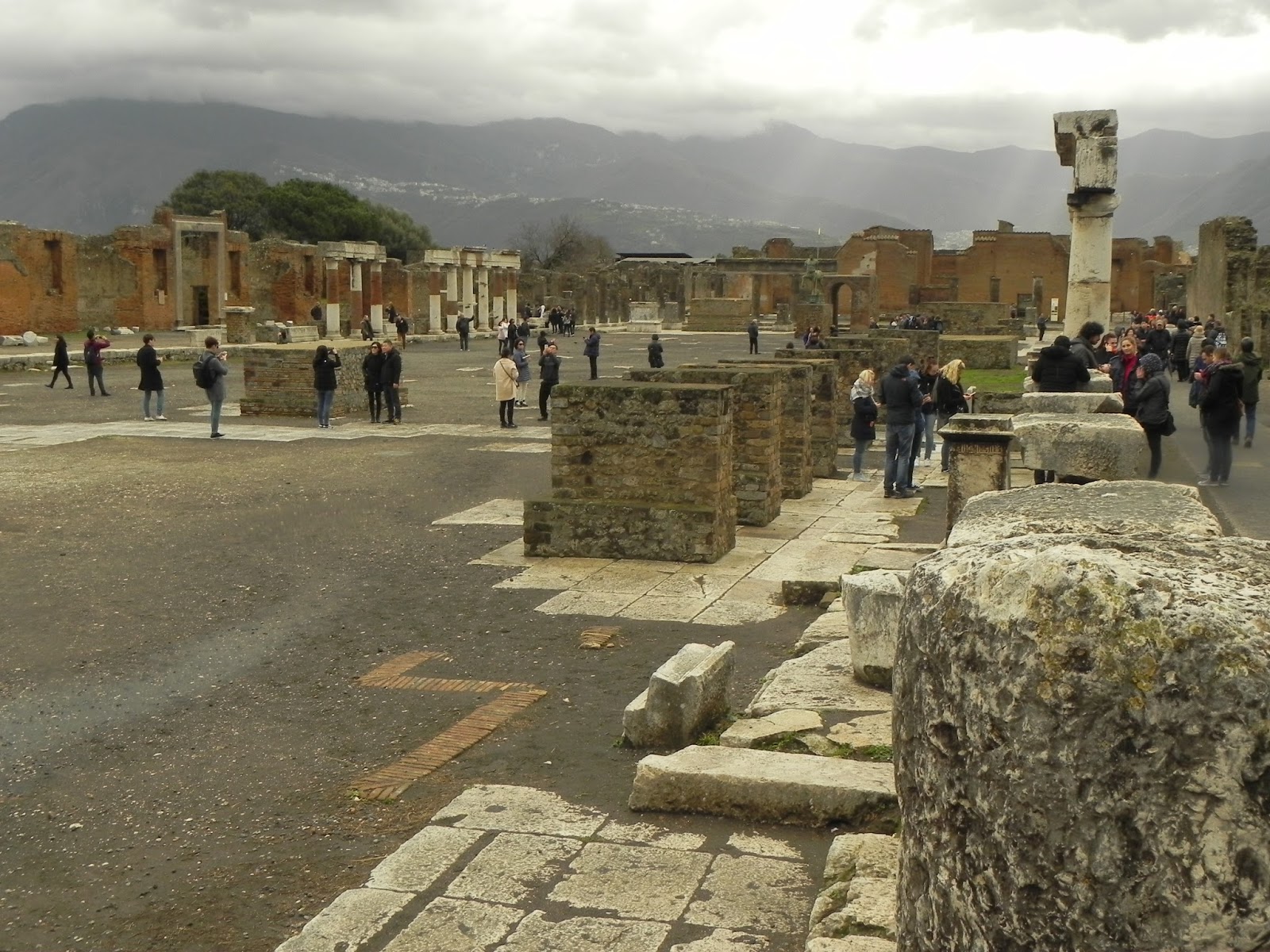
The Forum.  The town center that contained temples to the gods with the most mojo, civic buildings and spaces, monumental Roman architecture and some muscular statues.  Romans did nothing halfway when it came to building stuff.
More of the Forum.  Arches and many of the columns were made of brick, then faced in marble or clad in concrete/plaster and shaped to look like marble.  The roads to Forum were lined with columns as was the perimeter of the Forum itself.  Must have been dang impressive then as it is dang impressive now.


A typical road, made of cut stone with elevated sidewalks.  The stones in the center of the roadway are for crossing to keep one's ancient feet dry. 
 Below is a statue of the centaur in the Forum.  This statue depicts a warrior from both Greek and Roman mythology.  This one however has a cool cut-out showing the Emperor in the rear.  Kind of creepy.

Below is a temple that stands at one end of the Forum.  Civic buildings were at the other, with a scattering of temples to gods that had fallen out of favor along the perimeter.  Then, like now, gods often had the best real estate.  


A statue on one approach to the Forum.  This warrier must have been pretty confident of his skills as the spear was the only thing he had on.  
 OK, now for the unfortunate part.  A lot of people and animals were also trapped.  Some remains were still present such as this line of skulls looking back at all the tourists looking at them.
 You may have seen photos of Pompeii showing the plaster casts of people that sheltered in buildings.  Abut 1000 "people" have been found.  Mostly all that was left was their shape in the hard ash.  Plaster was injected into the void to reveal the outline of people.  It tells a pretty tragic story.


Warehouses at the site display some of the casts, and many, many objects found in the city.  There are 1000s of ceramic vessels, plates, pottery, money, jewellery and all manner of stuff that were part of life when it came to a quick end 1900 years ago.


Man's best friend also was found.  

 On a lighter note, bread making was a brisk business.  There are lots of bakeries scattered about town.  Wheat was ground in the hour-glass shaped stone vessels.  A conical stone plug was placed into the top of grinding vessel and turned by donkeys.  Ground wheat came out the holes in the side.  Bread was made on the spot and baked in ovens nearby.
A bread oven.  Still standing after nearly 2000 years.  Some ovens still had carbonized bread in them

 Houses, shops and businesses were all set in close quarters along most streets.  Apparently zoning had not yet been discovered.  Here is a road less travelled that held mostly houses, I think.  Ruts in most roads are plainly visible worn by wagon traffic.

Houses of the wealthy were pretty huge.  These structures, belonging  to the ancient 1% had dramatic tall entrance doors, and an atrium with an artistic catch basin that opens to a colonnaded courtyard.  Rooms off the atrium and courtyard often were decorated with painted plaster and mosaic floors.  I was floored to see in one home a mosaic of Aleksandar the Great.  Hey, he belongs to Macedonia!  Or, maybe Greece!  Or, maybe Thrace.  But here he is in Pompeii Italy,  locked in battle with his arch-enemy King Darius.  This is probably the most famous image to old Alex (and he won this battle as he violently moved on to India).

A couple houses had warning signs at their entrances, only being Romans they did it in a big way.  Here is one mosaic that simply says "Beware of Dog".  No dog was present when we visited however.

Pompeii citizens seemed to live pretty well and enjoyed access to large public baths, and to the right, one of two theatres.  This one held only a couple thousand.
The really big shows took place in the coliseum.  This one could fit about 20,000 people and here are the stairs to the cheap seats.  It could be partially covered with awnings to provide shade and that comfy ambiance necessary for gladiatorial combat.

The space below the colosseum had access for people, props and animals.  It was built for the long term like most Roman public structures.

The lower decks provided the best viewing and were used by today's equivalent of season ticket holders.  

Glass vessels were available when the good company dishes were needed.


Houses were adorned with art, wall paintings and gardens.  Below is a bronze of "the Fawn" from a large house.  This statue sits in the shallow rain-fed basin located inside the entrance of most of the larger houses.  Not sure if he is really happy to see guests  or running from the family dog.  . . .

Wall art was important and a feature of pretty much every home.
Here is a fresco, paint over plaster, from another home.  This one shows a woman holding a head.  Not sure what's up, but not very neighbourly.  The head seems a bit surprised about this, too. 


More frescos from the same series.  They calmed down a bit and show a man reading a book, and a woman holding a globe.  A bit more comforting than the head lady.


Finally - after food, head chopping, gladiatorial contests and just doing Roman stuff, what better way to end the day than with a good soak?  Here is a bath from a house where you could relax, think big thoughts, and get ready for the next day that never came.

Pompeii was quite astounding, and shows how people lived and otherwise almost two millennia ago.   These pictures show only a very small part of the town, and areas are still being excavated.  It is definitely a bucket list kind of place, and the sights, both good and ghastly, tell an amazing story.
Al